
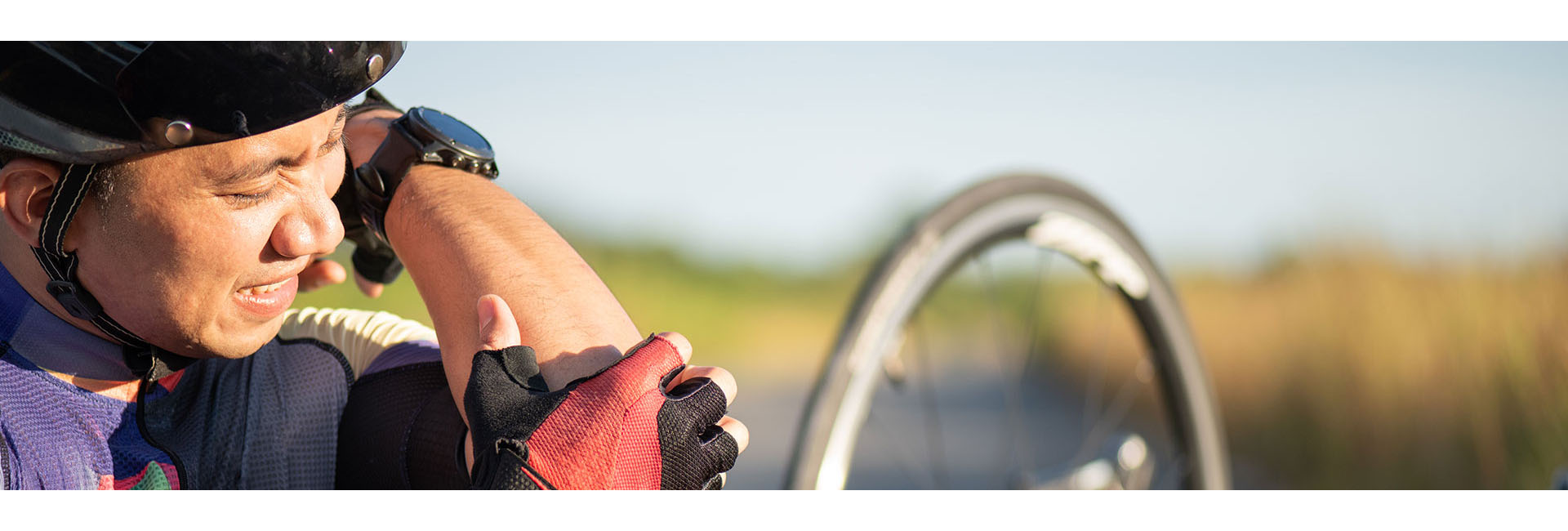
Forearm fractures can be crippling for an adult, since most of the everyday activities, right from getting dressed up to picking grocery bags, involve forearm activity. Forearm fractures occur when either or both bones in the forearm, i.e. “radius” and “ulna”, get damaged. The damage can range from a slight crack to a complete shatter or a fracture which involves bone displacement.
In severe cases, the fractured bone fragments can lead to infection when projected outward from the skin. In these cases, it is important to immediately consult an Orthopedic.
Anatomy of the Forearm
Bones in the Forearm
The forearm, commonly referred to as the wrist, is a simple but still complex part of the body. Comprised of two parallel bones, the radius and ulna, the wrist is capable of twisting motions. The radius is the long bone in the forearm that is on the thumb side. The radius is both shorter and thicker than the ulna. The ulna is on the outside of the forearm, running from the elbow to the pinkie side of the hand. If you open your hand and twist it then you will notice your pinkie doesn’t move much and your thumb rotates around your hand. If you ever find yourself in an anatomy test just remember that the radius rotates.
Nerves in the Forearm
There are three main nerves in the forearm: the median nerve, ulnar nerve and radial nerve. All three of these nerves are very important to the feeling in the arm and hand. In the case of a forearm fracture the order of importance to be aware of is blood supply, nerve transmission and then the bone shape. If these nerves become impinged from inflammation outside of a fracture the conditions are ones you may have heard of. The median nerve is responsible for a well-known condition called carpal tunnel. The radial nerve is responsible for radial tunnel syndrome, and ulnar nerve is responsible for cubital tunnel syndrome. The ulnar nerve is also responsible for the well-known but disliked experience we call “hitting your funny bone.”
Types of Forearm Fracture
Fractures of the forearm can be isolated to one wrist bone, or both the radius and ulna. The term distal may be used to indicate the third of the bone closest to the hand, medial for the center third or proximal for the third closest to the elbow. An example of this terminology in use would be a distal radius fracture. The fractures in pediatric patients could include important regions of the bone called growth plates, or epiphyseal plates, resulting in an urgent fracture called a Salter-Harris fracture. Roughly 15% of long bone fractures in pediatric patients are Salter-Harris fractures and require specialized splinting or emergency surgical fixation before the bone begins to heal. Some fractures will require surgical correction and may utilize plates, screws, pins, rods and even wrist arthroscopy. Just like any other fracture of long bones the pattern can vary. Common types of fractures of long bones include:
Comminuted Forearm Fracture
The fracture splinters or shatters into two or more pieces. In the forearm this type of fracture can occur in either, or both, the radius or ulna. Fractures of this nature may require surgical intervention to maximize the quality of life after healing. If both bones are fractured then surgery is always indicated.
Transverse Forearm Fracture
A transverse forearm fracture is simple, straight and perpendicular to the plane of the bone. If the fracture occurs in the radius or ulna then the patient may be able to heal with just a cast. If both bones are affected then surgery is always indicated.
Spiral Forearm Fracture
A spiral forearm fracture is shaped like a corkscrew wrapping around the bone or bones. This type of fracture is prone to complications and may require emergency surgical intervention to restore blood flow or nerve conduction. Spiral fractures occur when the bone is subjected to a twisting force or impact greater than the bone can withstand.
Oblique Forearm Fracture
Oblique forearm fractures happen when the bone is broken at an angle, such as 45 degrees to the plane of the bone. A fracture of this nature is going to make the two pieces of bone look sharp from the angulation. If just the radius or the ulna are affected then the patient may be a candidate for a cast, but if both bones are broken then surgery is indicated.
Avulsion Forearm Fracture
In an avulsion forearm fracture a piece of bone has broken away from the joint where a tendon connects. The tendon can retract away from the joint carrying the piece of broken bone with it. Avulsion fractures in the forearm vary from surgical interventions to closed fixations. Evaluation will need to be completed by an orthopedic specialist quickly.
Impacted Forearm Fracture
An impacted forearm fracture is just as it sounds, a fracture that occurs from jarring impact. Impacts cause pressure on the bone that can cause fracture. If the pressure is from the side the bone may snap, but when the pressure is jarring the body pushes back and the bone can crush at the weakest point.
Fissure Forearm Fracture
A fissure forearm fracture is often referred to as a hairline fracture. Fissure fractures are non-displaced fractures that are nothing more than small cracks in the bone. These can be painful but heal well if the stressor is eliminated and care is taken to rest the area while healing. If they are not properly healed, they can graduate to a full-thickness fracture.
Greenstick Forearm Fracture
A greenstick fracture is rarely found outside of children because they have softer bones than adults. A greenstick fracture happens when a force large enough is applied to the bone to break it, but because of the elasticity of children’s bones the fracture only happens on one side of the bone. One of the most common types of greenstick fractures is from when a child falls on their hands with outstretched arms causing what is referred to as a torus, or buckle, fracture.
Causes of Forearm Fracture
Direct blow or impact to the arm – This could be caused by a fall, automobile accident, sports accident, etc. Forearm fractures are usually caused by impact on an outstretched arm. The fracture results when the arm is stretched or twisted beyond its normal range of motion.
Symptoms of Forearm Fracture in Adults
- Swelling
- Localized bruising around the site of injury
- Tenderness
- Immediate pain upon injury/impact
- Obvious deformity – The affected arm is visibly bent or distorted
- In rare cases, the fracture can be accompanied with numbness in the fingers or weakness in the wrist.
- Difficulty in performing normal activities involving the forearm.
Treatment
The treatment for sports-related adult forearm fractures starts with a detailed analysis of the extent of damage, by an orthopedic doctor.
- Restricting movement of the affected bone is critical to the treatment of forearm fractures since moving the broken bone can cause injury to the surrounding tissues and blood vessels.
- Anti-inflammatory drugs and pain-killers can be administered to get rid of pain and swelling.
- For certain severe cases of forearm fractures, surgical treatment could be required. One of the most common surgical procedures adopted for adult forearm fractures is open reduction using screws and plates, in which the bone fragments are realigned into their original position and secured with screws. It is important for the realignment of the bones to be accurate during surgery for the injury to heal correctly.
OrthoTexas, a group of orthopedic surgeons and physicians serving various locations across North Texas, offers advanced treatment for adult forearm fractures.
Your path to recovery starts here. Schedule an appointment with OrthoTexas or find a location near you.