
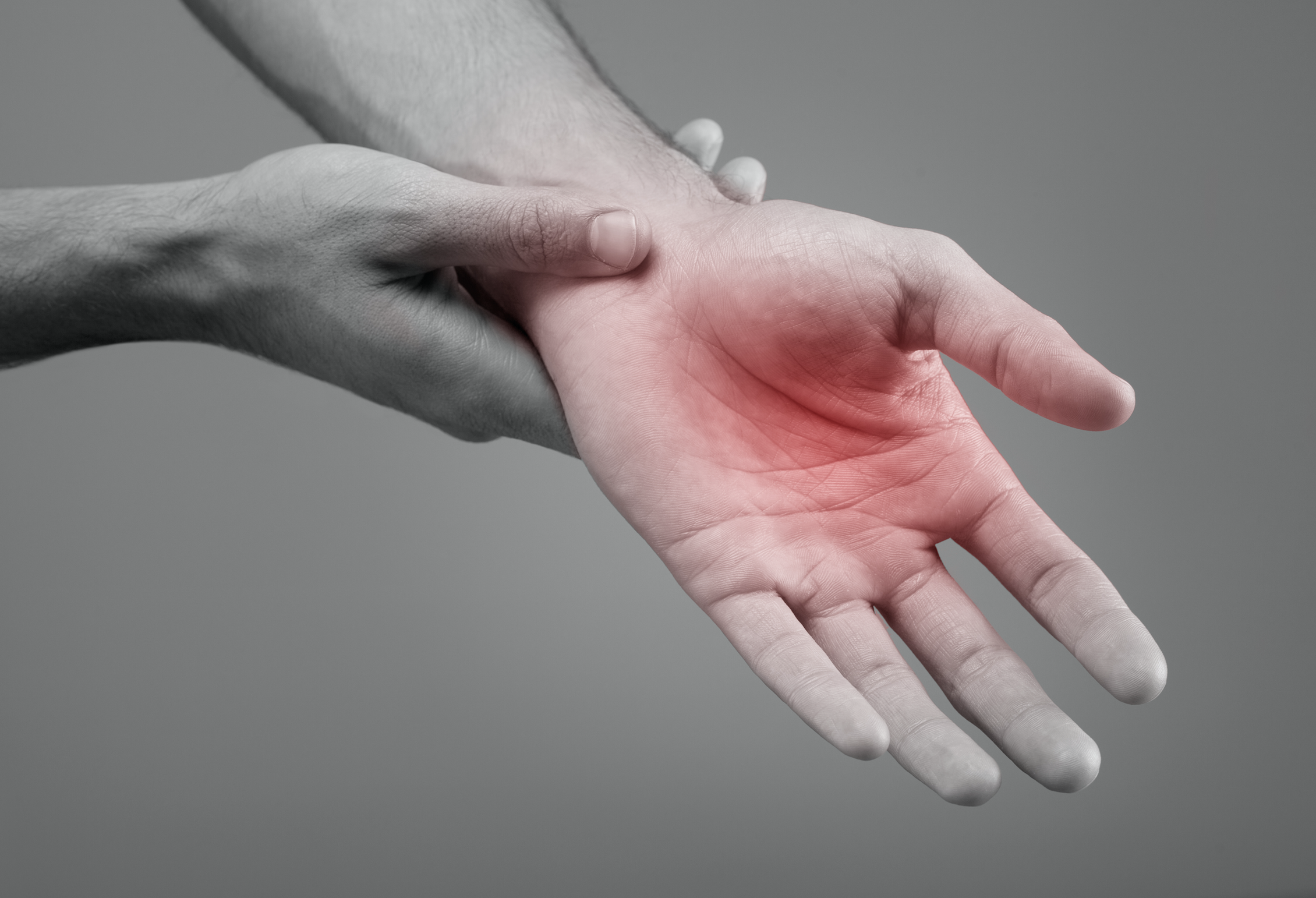
As we age, our bodies become less resilient and more susceptible to the wear and tear from our daily activities. Our hands, fingers and wrists are just as likely to exhibit issues as our knees, hips and backs. Inflammation, fraying of tendons, autoimmune responses, degenerations of cartilage, reduced density of bone, deconditioning of support muscles, all can be contributing factors leading to aches, pains and debilitations that can manifest as a wide spectrum of disorders. When hand pain, finger pain or wrist pain hits, it can make day-to-day life tough. Here are some of the common causes:
Your Guide to Hand Pain
Osteoarthritis
- Osteoarthritis is the erosion of the smooth cartilage padding at one or both ends of the bones that meet in any joint. This causes the eventual rubbing of two bones together, which can cause inflammation and pain. Osteoarthritis often affects the end joints and middle or end joints of the fingers, leading to bony nodules, pain and stiffness. The base of the thumb is a common site for osteoarthritis, often causing pain and swelling. Rheumatoid arthritis could be a possible autoimmune cause for the deterioration of the cartilage in the hand. Other causes could be from anatomical imbalances or repetitive motion. Osteoarthritis in the hand, such as basal joint osteoarthritis, can cause hand pain, finger pain, joint swelling and even joint deformation. Hand arthritis is a common cause of joint pain, and recognizing symptoms such as pain and stiffness is important for diagnosis. Nonsteroidal anti-inflammatory drugs and other pain relievers are commonly used to provide relief from symptoms. Steroid injections may be considered if other treatments fail, and surgery is a last resort.
Carpal Tunnel Syndrome
- The carpal tunnel is a passageway for the nerves and tendons to travel through your wrist and into your palm to your fingers. The carpal tunnel is a narrow space, and compression in this area can lead to nerve damage causing pain and numbness. Carpal tunnel syndrome is where the passageway narrows for a variety of reasons, both genetic and activity based causing numbness, tingling or hand pain. Repetitive motions or vibrations can cause irritation that leads to inflammation of the passageway putting pressure on the median nerve which is responsible for the control and feeling of the thumb, pointer and middle fingers. In cases where the inflammation cannot be controlled by activity modification, physical therapies or medications, surgical intervention may be necessary to prevent possible or further damage to the median nerve.
Cubital Tunnel Syndrome
- The cubital tunnel is a passageway for the ulnar nerve to pass from your upper arm through your elbow and into your forearm. Ulnar nerve entrapment can give symptoms of “falling asleep” in the ring finger and little finger, especially when the elbow is bent. There may be an aching pain on the inside of the elbow. In some cases, it may be difficult moving the fingers in and out or manipulating objects. Numbness and tingling in the ring finger and little finger are common symptoms of ulnar nerve entrapment. Often, these symptoms come and go. They happen more often when the elbow is bent, such as when driving or holding the phone. Some people wake up at night because their fingers are numb.
- Weakness of grip and difficulty with finger coordination (such as typing or playing an instrument) may occur.
- If the nerve is very compressed or has been compressed for a long time, muscle wasting in the hand can occur. Once this happens, muscle wasting cannot be reversed. For this reason, it is important to see the doctor as soon as any symptoms are noticed.
Trigger Finger
- This is caused by swelling in the tendon sheath around the flexor tendons in your hand as well as the tendon itself. If you try to straighten your hand from a fist and a finger catches resistance in the bent position and then pops through the rest of the motion quickly to the straight position you may have trigger finger. The condition can affect any finger, and identifying the affected finger is important for treatment. The tendon sheath and tendon sheaths play a key role in causing pain and stiffness in the trigger finger.
- Symptoms of trigger finger usually start without any injury, although they may follow a period of heavy hand use. Symptoms may include: a tender lump in your palm, swelling catching or popping sensation in your finger or thumb joints, pain when bending or straightening your finger. Stiffness and catching tend to be worse after inactivity, such as when you wake up in the morning. Your fingers will often loosen up as you move them. Sometimes, when the tendon breaks free, it may feel like your finger joint is dislocated. In severe cases of trigger finger, the finger cannot be straightened, even with help. Sometimes, one or more fingers are affected. An ice pack and anti-inflammatory medications can help reduce swelling and provide relief. A steroid injection is sometimes used if symptoms persist.
De Quervain’s Tenosynovitis
- A condition causing hand pain in the tendons located on the thumb side of your wrist. De Quervain’s tenosynovitis is the most common type of tenosynovitis affecting the tendon sheath at the base of the thumb. De Quervain’s tenosynovitis usually occurs from overusing your thumb or wrist, especially in activities that move your thumb directly away from your wrist such as skiing or hammering. Like trigger finger in that it is caused by swelling in the sheath around the tendon, De Quervain’s tenosynovitis separates itself from trigger finger in that the swelling does not include the tendon itself and it only affects the thumb. Irritated tendons and inflammation of the tendon sheath are the main causes of this painful condition.
Dupuytren’s Contracture
- An abnormal thickening of the tissue just beneath the skin in the palm and can extend into the fingers. Firm pits, nodules and cords may develop that can cause the fingers to bend into the palm, which is a condition described as Dupuytren’s contracture. Although the skin may become involved in the process, the deeper structures — such as the tendons — are not directly involved. Occasionally, the disease will cause thickening on top of the finger knuckles (knuckle pads), or lumps or cords within the soles of the feet (plantar fibromatosis).
- The initial lumps may produce discomfort that usually resolves, but Dupuytren’s disease is not typically painful. The disease may first be noticed because of difficulty placing the hand flat on an even surface, such as a tabletop. As the tissue thickens and fingers are drawn into the palm, one may notice increasing difficulty with activities such as washing, wearing gloves, shaking hands and putting hands into pockets. This is a painful condition that can cause pain and stiffness in the affected joint.
- While surgical correction used to be the likely treatment available, due to advances in technology a collagenase called Xiaflex can now be used to release your finger without surgery.
Fracture
- Hand deformity after a trauma is an obvious sign of a fracture, but less obvious fractures can present swelling, tenderness, bruising, the inability to move fingers or hand pain that worsens when in use. Fractures can occur in any finger joint or affected joint, and identifying the affected joint is important for treatment. If you suspect a fracture, go ahead and book an appointment with an orthopedic specialist immediately and let them know that you suspect a fracture. Bones begin to heal, sometimes incorrectly, in as little as five to seven days, so the easiest option is to be seen quickly before treatment becomes more complicated and expensive.
Ganglion Cysts
A cyst is a fluid-filled sac. Ganglion cysts arise from the capsule of a joint or the sheath of a tendon. They can be found at different places on the wrist. A ganglion cyst that grows on the top of the wrist is called a dorsal ganglion. Others are found on the underside of the wrist between the thumb and your pulse point, at the end joint of a finger or at the base of a finger. Most of the time, these are harmless and can disappear in time. Ganglion cysts can develop for no apparent reason and may cause pain by pressing on nerves.
- Because the fluid-filled sac puts pressure on the nerves that pass through the joint, some ganglion cysts may be painful. Large ganglia, even if they are not painful, are unattractive. Smaller ganglions that remain hidden under the skin (occult ganglions) may be quite painful. A ganglion grows out of a joint, like a balloon on a stalk. It rises out of the connective tissues between bones and muscles. Usually, the more active the wrist is, the larger the cyst becomes. With rest, the lump can decrease in size. Nonsteroidal anti-inflammatory drugs and other treatments may be used to reduce swelling and provide relief.
Nerve Injury
- While most nerve injuries of the hand are traumatic in nature, if you are experiencing tingling, numbness, radiating pain or aching, or loss of hand strength it is time to come and see an orthopedist to rule out nerve impingement just in case to avoid nerve compression becoming permanent damage. Nerve damage can result from trauma or compression, causing pain, numbness and weakness.
Jammed Finger
- For many of us a familiar type of hand pain is caused by the finger being forcibly pushed back into the hand. Technically a jammed finger is just a sprain of the finger, but with possible pain, bruising, tenderness and swelling it is hard to tell the difference between a sprain and a minor fracture. An ice pack and rest are common treatments to reduce swelling and pain. If you are ever in doubt, it is safer to go ahead and see a physician for an X-ray to rule out a fracture.
Mallet Finger
- Caused usually by traumatic damage to the tendon that straightens the finger. This causes a deformation with the end of the finger uncontrollably bent down. The injury typically affects the end joint of the finger. After a finger fracture is ruled out, most mallet fingers can be healed simply with a splint and time.
Tumors
- While most hand tumors are luckily benign, it is always important to see a physician to rule out other possibilities as early as possible. Tumors in the hand can sometimes be a painful condition causing pain and restricted movement.
Basic Anatomy of the Hand
The hand is a remarkably complex structure, designed for both strength and precision. It is made up of 27 bones, including the phalanges in the fingers, the metacarpal bones in the palm and the carpal bones that form the wrist. These bones are connected by a network of muscles, tendons and ligaments that allow for a wide range of movements, from gripping to fine motor tasks. The median nerve is a key player in hand function, running from the forearm through the carpal tunnel in the wrist and into the hand. This nerve provides sensation and motor control to the thumb, index finger and middle finger, making it essential for tasks that require dexterity. Understanding the anatomy of the hand is crucial for diagnosing the source of pain, whether it’s related to the bones, joints or nerves, and for developing effective treatment plans to restore hand function and ease pain.
Understanding Hand Pain
Hand pain is a frequent issue that can disrupt daily life, whether it affects one or more fingers, the wrist or the entire hand. This discomfort can stem from a variety of sources, including injuries, repetitive use or underlying health conditions such as arthritis or carpal tunnel syndrome. The pain may be mild and occasional or severe enough to limit hand function and interfere with routine activities. In many cases, hand pain is linked to inflammation or pressure on nerves, such as the median nerve in carpal tunnel syndrome, which can cause numbness and tingling in the fingers. Common treatments for hand pain include rest, the use of ice packs or cold therapy to reduce swelling, pain medications and physical therapy to restore movement and strength. For persistent or severe cases, surgery may be required to relieve pressure on nerves or repair damaged joints or tendons. If you experience ongoing pain, stiffness or other symptoms in your hand or wrist, it’s important to seek medical advice to identify the cause and explore the best treatment options.
How to Reduce Crippling Hand Pain
To reduce crippling hand pain, practical strategies include using pain relievers, nonsteroidal anti-inflammatory drugs, ice packs and physical therapy. These approaches can help provide relief from pain and stiffness, reduce swelling and improve quality of life for those suffering from severe hand pain.
Nerve-Related Conditions
Certain nerve-related conditions can also be responsible for hand pain and discomfort. Peripheral neuropathy occurs when the nerves in the hand are damaged, leading to symptoms such as numbness, tingling and pain in the fingers. This condition can be caused by diabetes, injury or other health issues that affect nerve function. Another condition, Raynaud’s disease, impacts the blood vessels in the hand, causing them to constrict in response to cold temperatures or stress. This narrowing of the blood vessels can result in pain, numbness and tingling, particularly in the fingers. Managing these conditions often involves a combination of physical therapy, medications to improve nerve or blood vessel function, and lifestyle adjustments to reduce symptoms. In severe cases where symptoms persist or worsen, surgery may be necessary to repair damaged nerves or restore proper blood flow. If you notice persistent tingling, numbness or pain in your hands, it’s important to consult a healthcare provider for an accurate diagnosis and appropriate treatment.